Sofa
Use this game to help your child if they’re feeling very anxious or scared
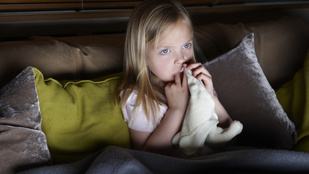
Children do not, first and foremost, have to come to terms with a frightening object, person or situation in real life – as that would be far too terrifying and risky for them – but rather in another world, one interwoven with fantasy. They slip into roles, endow themselves with special powers and abilities, and take control of the action so that their fear is diminished and thus becomes surmountable.
Fears in childhood are common in almost every family. Ranging from separation anxiety to loud noises (balloons, vacuum cleaners), the in the dark And beyond monsters, anything that periodically frightens a child – right up to the fear of rejection – is possible. As adults, these fears often seem unrealistic, or perhaps exaggerated, yet tackling them is by no means an easy task. We want to protect, encourage and reassure our children that there really is nothing to be afraid of, but our unsuccessful attempts can stir up uncertainty and fear within ourselves, and make us doubt whether we are good parents.
Fear is an important part of life, as it teaches us responsibility, self-defence and survival; rejecting it is therefore not advisable. We must not shield our children from feeling fear, but rather from allowing fear to take control of them and paralyse them. Everyone is afraid of something, whether they are a child or an adult. It is not the person who feels no fear who is brave, but the one who can overcome their fear. To do this, we must be able to recognise it, accept it, and create opportunities to process it and resolve the problem. For children, play is the primary means by which they can relive all those experiences that have caused them a great deal of voltage (whether positive or negative) they have generated within themselves, and in this way they learn to manage them. Role-play and puppet shows have proved to be the most effective ways of overcoming fear.
Children need to be able to experience their fears outside of real life
In reality, fear usually takes a child by surprise – either because they weren’t expecting it, or because they didn’t know how to prepare for it. The younger a child is, the less able they are to protect themselves. They are at the mercy of their environment and the – sometimes uncomprehending – adults around them. Through play, the child is given the opportunity to relive the events that have affected them in such a way that they no longer take them by surprise. In this way, they can safely anticipate the consequences, or perhaps even influence them of their own accord, in accordance with their own inner feelings.In this way, the child slips into a role, endowing themselves with special rights and abilities, and directs the course of events so that their fear is diminished and becomes surmountable. Through their imagination, they make up for what they still lack within themselves – something that could protect them next time – thus allowing their inner tension to be relieved.
The child does not, first and foremost, need to come to terms with the object, person or situation that causes fear in real life – as that would be far too frightening and risky for them – but rather in another world, one interwoven with imagination. By recognising the importance of role-play in processing emotions and experiences, we as parents can support our child in coming to terms with their fears. By creating as many opportunities as possible for this free – child-led – play, and perhaps taking on a (passive) role in it, we can strengthen their problem-solving skills and experience what it is like when they are able to find peace on their own.
Within role-play, puppetry can provide the most comprehensive support
One of the biggest challenges for young children is learning to come to terms with their emotions. It takes time for them to learn to control their own intense, extreme and uncontrollable emotions, just as it takes time for them to understand the constant duality of life’s emotions – that is, that good and bad often go hand in hand (e.g.a parent is sometimes a good fairy, sometimes a wicked witch). The resulting inner their tensions and the fears they develop are very common, so addressing these also deserves attention.
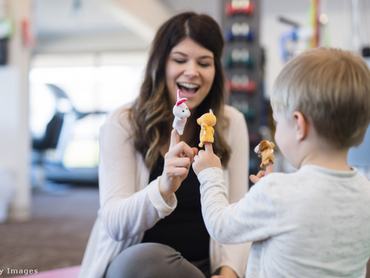
Even within the realm of role-play, puppet shows can be of the greatest help to them; however, this does require adults to take the initiative and set a good example. Through puppetry, fears are shifted even further into another world and re-enacted by others, allowing the child to identify with the characters without having to consciously recognise themselves in them. Johanna Friedl Games to help overcome fear In his book entitled …, the term „”shy little bunny" a puppet who regularly finds himself in emotionally difficult situations. As the shy little rabbit faces his difficulties, he pours his heart out to the child and asks for help in solving the problem. They keep trying together until they find a real solution. According to the author’s suggestion, using this (or a similar) character can be an excellent starting point, as it allows the child to really get to know the character and, in the long term, to form a kind of bond with them, which also provides emotional security.
Important rules for role-play and puppet shows
Role-play and puppetry can be a great help to children in overcoming their fears. Taking on or projecting desired roles onto the characters provides the necessary distance, allowing children to act out and work through highly stressful and fear-inducing experiences. Our role as parents and our attitude in this regard, however, deserve attention, as it is no coincidence that these activities are called „free” play. In order for children to truly be able to express their inner struggles, we must respect those borders, which, if crossed, can easily become an obstacle. To prevent this and ensure appropriate support, Friedl draws our attention to a few important basic rules:
- If we take part in role-play or puppet theatre as adults, it is important not to take the lead, but rather to let the child guide us!
- Ideally, the game should feature as many characters as possible, embodying different roles and clearly defined personalities (female, male, good, bad, etc.)!
- Let’s also create neutral, expressionless figures that the child can use as they see fit!
- Let’s keep the figures in a fixed place where the child can always reach them whenever they need them!
- Let them choose the setting for their play!
- Let’s avoid moral judgements and labelling so that children can freely express their feelings!
Childhood fears They usually only occur from time to time. As children grow and develop, and with the support of a secure emotional environment within the family, these fears generally resolve themselves. However, our understanding of the subject can help to ease and even shorten these periods, as with the right support we can be there to help our child exactly where they need it. And this, in turn, can only deepen our bond.
Originally published on: divany.hu, 24 November 2020.